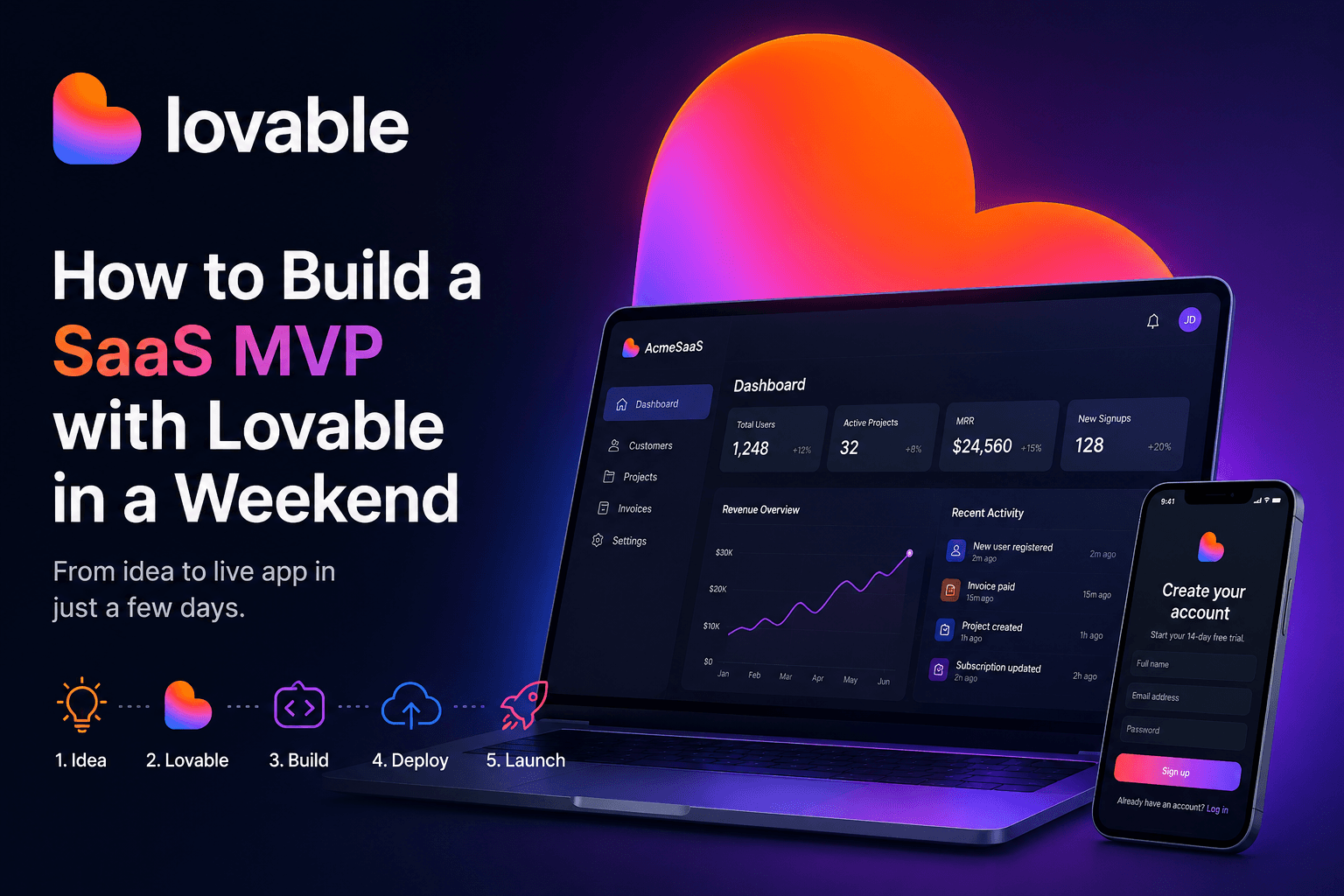
How to Build a SaaS MVP with Lovable in a Weekend
Learn how to build a full-featured SaaS MVP using Lovable AI in just one weekend. Step-by-step guide covering planning, prototyping, deployment, and user validation.
Last updated: May 2026
Launching a Software-as-a-Service (SaaS) product used to require months of development, large engineering teams, and significant financial investment. Today, AI-powered development platforms have dramatically changed that reality. Tools like Lovable allow founders, entrepreneurs, and product teams to transform ideas into working applications in a matter of days rather than months.
For startups, speed is often the difference between success and failure. The ability to validate an idea quickly, gather user feedback, and iterate before competitors can provide a significant advantage. That's why many founders are turning to Lovable to build Minimum Viable Products (MVPs) faster than ever before.
In this guide, you'll learn how to build a SaaS MVP with Lovable in a single weekend, from idea validation to deployment.
Why Build an MVP First?
An MVP is the simplest version of a product that solves a real problem for users.
Instead of spending months developing dozens of features, an MVP focuses on delivering the core value proposition as quickly as possible.
The benefits include:
- Faster market validation
- Lower development costs
- Earlier customer feedback
- Reduced business risk
- Quicker product iterations
- Better product-market fit discovery
Many successful startups began with extremely simple MVPs before evolving into mature products.
What Is Lovable?
Lovable is an AI-powered application development platform that enables users to create web applications using natural language instructions.
Rather than manually coding every component, users describe what they want to build, and Lovable generates:
- User interfaces
- Application logic
- Database structures
- Authentication systems
- Backend functionality
- Integrations
This dramatically reduces the time required to launch functional software products.
Step 1: Choose a Problem Worth Solving
Before opening Lovable, define the specific problem your SaaS will solve.
Avoid trying to build a complex platform with dozens of features.
Instead, identify:
- A clear target audience
- One primary problem
- One core solution
- One measurable outcome
Examples include:
- Appointment scheduling for consultants
- Lead management for agencies
- Invoice generation for freelancers
- Internal CRM systems
- Content planning tools
- Client onboarding platforms
The narrower the initial focus, the faster you can launch.
Ask Yourself
Can I explain the product in one sentence?
If not, the idea may be too broad for an MVP.
Step 2: Define Your Core Features
The biggest mistake founders make is including too many features.
For a weekend MVP, focus only on essential functionality.
For example, if you're building a lead management SaaS:
Must-Have Features
- User registration
- Login authentication
- Lead creation
- Lead editing
- Lead status tracking
Nice-to-Have Features
- Advanced reporting
- Team collaboration
- API integrations
- Custom workflows
- Mobile apps
Ignore the nice-to-have features initially.
Your goal is validation, not perfection.
Step 3: Create Your First Prompt
The quality of your results depends heavily on your instructions.
Instead of writing vague prompts like:
"Build a CRM."
Use detailed prompts such as:
"Create a SaaS CRM for marketing agencies. Users should be able to register, log in, create leads, edit lead information, assign statuses, and view leads in a dashboard. Include a modern responsive design and PostgreSQL database structure."
Specific prompts produce significantly better outputs.
Step 4: Generate the Initial Application
Once your prompt is ready, Lovable can begin generating the foundation of your application.
Within minutes, you'll typically receive:
- Landing pages
- Authentication flows
- Dashboard layouts
- Navigation systems
- Database models
- CRUD functionality
This stage often eliminates days or weeks of manual setup work.
Review everything carefully before moving forward.
Remember that AI-generated applications should always be inspected and refined.
Step 5: Improve the User Experience
After generating the initial version, focus on usability.
Ask Lovable to improve:
- Navigation
- Form layouts
- Mobile responsiveness
- Dashboard organization
- Visual consistency
- User onboarding flows
Example prompt: "Improve the dashboard design with clearer navigation, cleaner spacing, responsive mobile layouts, and a more professional SaaS appearance."
Small design improvements can dramatically increase perceived product quality.
Step 6: Add Authentication and User Management
Most SaaS applications require user accounts.
Ensure your MVP includes:
- User registration
- Login functionality
- Password reset
- Protected routes
- Session management
Authentication is one of the first elements potential users will interact with, making reliability essential.
Many founders choose to integrate authentication providers early to simplify security management.
Step 7: Connect a Database
Your SaaS product needs persistent data storage.
Depending on your use case, you'll typically store:
- User accounts
- Customer records
- Tasks
- Projects
- Documents
- Analytics data
Review generated database structures carefully and ensure they align with your business requirements.
Good database design reduces future migration headaches as your user base grows.
Step 8: Test Every Workflow
Before showing your MVP to potential users, thoroughly test every feature.
Verify:
- Registration works correctly
- Login sessions remain active
- Data saves properly
- Forms validate correctly
- Mobile layouts function well
- Navigation flows smoothly
Even simple MVPs should provide a reliable user experience.
Early bugs can damage credibility and reduce valuable feedback opportunities.
Step 9: Integrate Essential Services
Many SaaS products benefit from a few key integrations.
Common examples include:
- Email notifications
- Payment processing
- Analytics tracking
- Customer support widgets
- CRM connections
For a weekend MVP, only implement integrations that directly support validation and user acquisition.
Avoid unnecessary complexity.
Step 10: Deploy Your Application
One of the biggest advantages of modern AI-powered development platforms is streamlined deployment.
Once testing is complete:
- Configure your domain
- Set environment variables
- Connect hosting services
- Enable SSL certificates
- Verify production functionality
Your MVP can often be live within hours of completing development.
This allows immediate feedback collection from real users.
Step 11: Get Real User Feedback
Many founders make the mistake of continuing development instead of seeking validation.
The objective of an MVP is learning.
Reach out to:
- Existing contacts
- Industry communities
- Potential customers
- Startup groups
- Social media audiences
Ask questions such as:
- What problem does this solve for you?
- What is confusing?
- What feature would you use most?
- Would you pay for this solution?
The answers are often more valuable than additional development.
Common Mistakes to Avoid
Building Too Much
Focus only on the smallest usable product. Every additional feature delays validation.
Ignoring User Feedback
Real customer feedback should guide future development decisions.
Prioritizing Perfection
Your MVP does not need enterprise-level polish. It needs to solve a problem effectively.
Skipping Testing
AI-generated code can contain errors. Always review and test critical workflows before launch.
Overcomplicating Architecture
Choose simple solutions until growth requires additional complexity.
What Can Realistically Be Built in a Weekend?
Using Lovable, many founders can create:
- Internal business tools
- Client portals
- Scheduling platforms
- CRM systems
- Lead management software
- Project management tools
- Directory websites
- Membership platforms
- Marketplace prototypes
- Workflow automation dashboards
The exact scope depends on project complexity, but a functional MVP is often achievable within two to three days.
The Future of SaaS Development
AI-assisted development is transforming how startups build products. Founders no longer need to spend months waiting for development resources before validating an idea.
Platforms like Lovable enable entrepreneurs to move from concept to launch faster than ever before, reducing costs and accelerating innovation.
While professional engineering remains important for scaling successful products, AI-powered development offers an unprecedented opportunity to validate ideas rapidly and efficiently.
Conclusion
Building a SaaS MVP no longer requires a large budget, a dedicated engineering team, or months of development effort.
With Lovable, founders can generate application foundations, implement core functionality, refine user experiences, and launch products within a single weekend.
The key is staying focused on solving one problem, keeping the scope small, and prioritizing real-world feedback over endless feature development.
Launch fast, learn quickly, and improve based on what users actually need. That's the true purpose of an MVP—and with Lovable, it's more achievable than ever.
Related Articles
ERP vs CRM: What's the Difference?
Understand the key differences between ERP and CRM systems: what each one does, their benefits, use cases, costs, the role of AI, and how to decide which system (or both) your business actually needs.
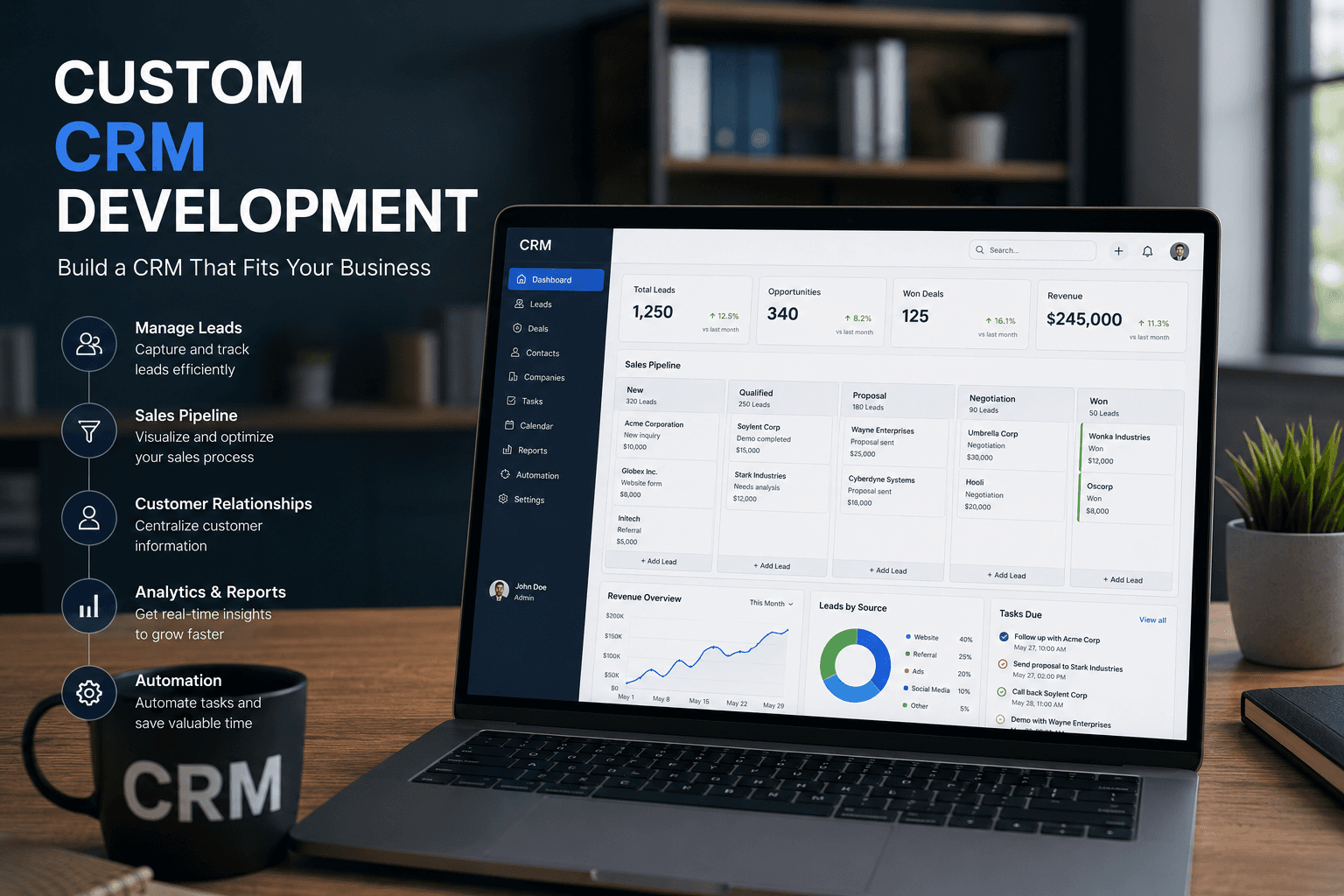
Custom CRM Development: Complete Guide
Everything businesses need to know about custom CRM development: what it is, benefits, essential features, AI-powered capabilities, costs, the development process, and how to decide if building a custom CRM is right for your company.