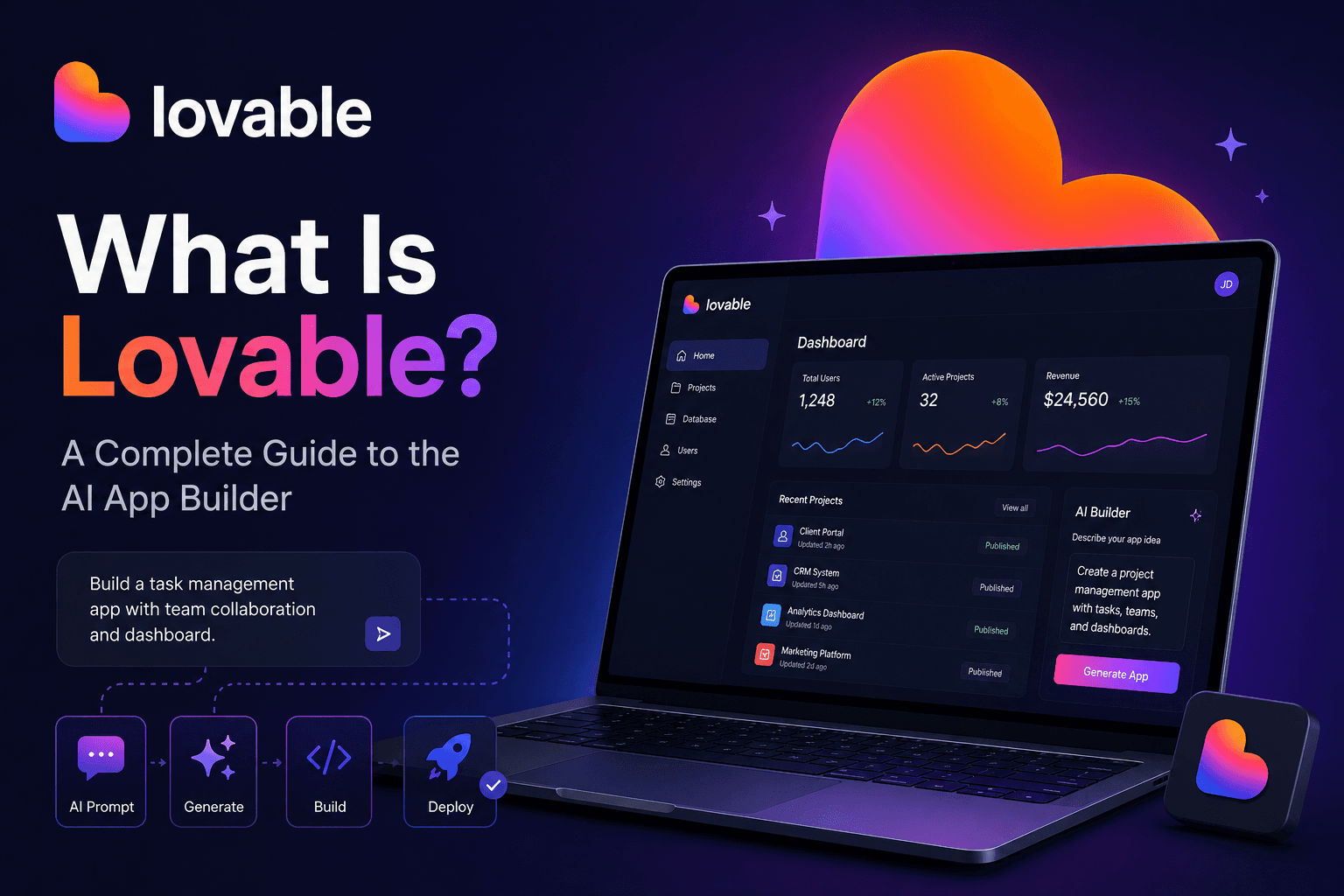
What Is Lovable? A Complete Guide to the AI App Builder
Everything you need to know about Lovable, the AI-powered app builder transforming software development. Features, use cases, limitations, and how it compares to traditional development.
Last updated: May 2026
Artificial intelligence is transforming nearly every aspect of software development. Tasks that once required weeks of coding, complex technical expertise, and large engineering teams can now be completed in hours with the help of AI-powered development platforms. Among the most talked-about tools in this rapidly evolving landscape is Lovable, an AI app builder designed to help users create web applications through simple natural language instructions.
Whether you're a startup founder looking to launch an MVP, a business owner building internal tools, or a developer seeking to accelerate workflows, Lovable offers a new approach to software creation that dramatically reduces development time and technical barriers.
In this complete guide, we'll explore what Lovable is, how it works, its key features, advantages, limitations, use cases, pricing considerations, and whether it's the right platform for your next project.
What Is Lovable?
Lovable is an AI-powered application development platform that enables users to build full-stack web applications using natural language prompts instead of traditional coding methods.
Rather than manually creating frontend interfaces, backend services, databases, authentication systems, and integrations, users simply describe what they want to build. Lovable then generates the application structure, user interface, business logic, and supporting components automatically.
For example, instead of writing hundreds or thousands of lines of code, a user might type:
"Create a CRM for marketing agencies with client management, lead tracking, user authentication, dashboards, and reporting features."
Within minutes, Lovable can generate a working application foundation that users can continue refining through additional prompts.
This approach significantly reduces development time while making software creation accessible to a much broader audience.
Why Is Lovable Becoming So Popular?
Traditional software development often involves:
- Technical planning
- Frontend development
- Backend implementation
- Database design
- Testing
- Deployment
- Maintenance
Even relatively simple projects can require weeks or months of effort.
Lovable changes this process by allowing AI to handle much of the repetitive implementation work automatically.
Several factors have contributed to its growing popularity:
Faster Product Development
Founders can move from idea to prototype in days rather than months.
Reduced Technical Barriers
Users without advanced programming knowledge can create functional applications.
Lower Development Costs
Businesses can validate ideas before investing heavily in engineering resources.
Rapid Iteration
Applications can be refined continuously through conversational instructions.
Increased Productivity
Developers spend less time writing boilerplate code and more time solving meaningful problems.
As startups and businesses increasingly prioritize speed and efficiency, platforms like Lovable have gained significant attention.
How Does Lovable Work?
The platform uses large language models and AI-assisted software generation to transform user requirements into functioning applications.
The process typically follows several stages.
Step 1: Describe the Application
Users begin by explaining what they want to build.
Examples:
- Customer relationship management system
- Appointment scheduling platform
- Project management tool
- SaaS dashboard
- Internal business application
- Marketplace platform
The more detailed the prompt, the better the generated results.
Step 2: AI Generates the Application
Lovable interprets the request and creates:
- User interface components
- Page structures
- Navigation systems
- Authentication flows
- Database schemas
- Business logic
- API connections
Users receive a working foundation rather than merely code snippets.
Step 3: Refine Through Conversation
Users can continue modifying the application using natural language.
Examples include:
- "Add dark mode support."
- "Create an analytics dashboard."
- "Add Stripe subscription billing."
- "Improve the mobile experience."
- "Create role-based permissions."
The platform updates the application accordingly.
Step 4: Connect Services and Deploy
Once the application is complete, users can integrate additional services and deploy their software to production environments.
This allows teams to launch functional products much faster than traditional development workflows.
Core Features of Lovable
Lovable includes numerous capabilities designed to simplify application development.
AI-Powered App Generation
The platform automatically creates software from plain English descriptions.
Instead of manually implementing features, users explain desired functionality and allow the AI to generate solutions.
This dramatically reduces initial development time.
Frontend Development
Lovable generates modern user interfaces automatically.
Features often include:
- Responsive layouts
- Mobile compatibility
- Navigation systems
- Forms
- Dashboards
- Interactive components
Applications typically follow modern design standards without requiring extensive design expertise.
Backend Logic Generation
Building backend systems traditionally requires significant engineering effort.
Lovable helps generate:
- Business logic
- Data processing
- CRUD operations
- User management
- Workflow automation
This simplifies development considerably.
Authentication Systems
Many applications require secure user access.
Lovable can generate:
- User registration
- Login systems
- Password recovery
- Session management
- Access control
Authentication functionality can often be implemented with minimal effort.
Database Integration
Applications depend on reliable data storage.
Lovable helps create and manage:
- Database schemas
- Data relationships
- User records
- Application content
- Business information
This eliminates much of the complexity associated with database design.
Third-Party Integrations
Modern software frequently relies on external services.
Common integrations include:
- Payment providers
- Email systems
- Analytics tools
- CRM platforms
- Marketing software
- Cloud storage solutions
Lovable simplifies integration workflows significantly.
What Can You Build with Lovable?
One of Lovable's biggest strengths is versatility.
The platform supports a wide range of application types.
SaaS Products
Many startups use Lovable to create:
- Subscription software
- Client portals
- Management systems
- Productivity platforms
- Industry-specific software
MVP development is one of the platform's most popular use cases.
Internal Business Tools
Organizations frequently build:
- Employee dashboards
- Workflow automation systems
- Approval processes
- Reporting tools
- Data management applications
These tools improve operational efficiency without requiring large development teams.
Customer Portals
Businesses can create:
- Client dashboards
- Account management systems
- Support portals
- Document sharing platforms
- Self-service applications
Customer-facing experiences can be launched quickly.
Marketplaces
Users can develop:
- Service marketplaces
- Vendor directories
- Booking platforms
- Product listings
- Community platforms
Many marketplace concepts can be validated rapidly using Lovable.
Project Management Software
Features commonly generated include:
- Task management
- Team collaboration
- Scheduling
- Reporting
- Progress tracking
Organizations can create customized productivity solutions tailored to their workflows.
Who Should Use Lovable?
The platform appeals to a wide range of users.
Startup Founders
Many founders lack technical backgrounds.
Lovable allows them to:
- Build MVPs
- Validate ideas
- Test markets
- Launch products quickly
This reduces dependency on large development budgets.
Entrepreneurs
Individuals exploring new business opportunities can create software products without assembling full engineering teams.
Rapid experimentation becomes significantly easier.
Agencies
Development and consulting agencies use Lovable to:
- Accelerate prototyping
- Improve delivery speed
- Reduce project costs
- Increase productivity
AI-assisted development can improve profitability while maintaining quality.
Product Managers
Product leaders can transform concepts into working prototypes for stakeholder reviews and user testing.
This improves communication and validation processes.
Developers
Professional engineers use AI tools like Lovable to eliminate repetitive tasks and focus on higher-value technical work.
Rather than replacing developers, the platform enhances productivity.
Advantages of Using Lovable
Several benefits contribute to the platform's growing adoption.
Faster Time to Market
Applications can often be developed in days instead of months.
Speed is especially valuable for startups seeking product-market fit.
Lower Development Costs
Businesses can reduce initial engineering expenses while validating ideas.
This lowers risk and improves capital efficiency.
Improved Productivity
AI handles repetitive implementation work, allowing teams to focus on strategic development tasks.
Easier Prototyping
Rapid prototyping enables faster learning and iteration cycles.
Organizations can test ideas before committing significant resources.
Greater Accessibility
Software creation becomes accessible to individuals without extensive programming experience.
This expands innovation opportunities across industries.
Potential Limitations of Lovable
While powerful, Lovable is not a perfect solution for every scenario.
Complex Enterprise Systems
Large-scale enterprise platforms often require specialized engineering expertise.
Highly customized architectures may still benefit from traditional development approaches.
Code Review Remains Important
AI-generated software should always be reviewed.
Developers should verify:
- Security
- Performance
- Scalability
- Maintainability
Human oversight remains essential.
Architectural Decisions Matter
Applications expected to support significant growth require thoughtful architecture planning.
Users should avoid assuming that generated software automatically satisfies long-term scalability requirements.
Learning Effective Prompting
Results depend heavily on prompt quality.
Users often improve outcomes as they gain experience communicating requirements clearly.
Lovable vs Traditional Software Development
Here's how Lovable compares to traditional development approaches:
- Development Speed: Lovable is extremely fast; traditional development is slower
- Initial Cost: Lovable is lower; traditional development is higher
- Technical Barrier: Lovable is lower; traditional development is higher
- MVP Creation: Lovable is excellent; traditional development is moderate
- Customization: Lovable is high; traditional development is very high
- Scalability: Lovable is good; traditional development is excellent
- Learning Curve: Lovable is easy; traditional development is steeper
- Iteration Speed: Lovable is fast; traditional development is moderate
Lovable excels at rapid product creation and validation, while traditional development remains advantageous for highly specialized enterprise solutions.
Lovable vs Other AI App Builders
As AI development platforms continue to emerge, Lovable is often compared with tools such as Bolt.new, Replit, Cursor, Windsurf, v0, Firebase Studio, and Claude Code.
Lovable's primary strength lies in its balance between ease of use and full-stack application generation.
It is particularly attractive to founders and businesses seeking to launch products quickly without extensive engineering resources.
Is Lovable Worth It?
For many users, the answer is yes.
Organizations that prioritize:
- Rapid prototyping
- MVP development
- Faster product launches
- Reduced development costs
- Increased productivity
can achieve significant value from the platform.
However, success still depends on proper planning, testing, and product strategy.
AI can accelerate development, but it does not eliminate the need for thoughtful decision-making.
The Future of AI-Powered Development
Lovable represents a broader transformation occurring across the software industry.
Artificial intelligence is increasingly becoming an active participant in software creation rather than merely a supporting tool.
Future development workflows will likely include:
- AI-generated applications
- Automated testing
- Intelligent deployment systems
- Architecture recommendations
- Self-improving software workflows
As these capabilities mature, platforms like Lovable may fundamentally reshape how digital products are built.
Conclusion
Lovable is one of the most compelling AI app builders available today. By allowing users to create full-stack web applications through natural language prompts, it dramatically reduces development complexity while accelerating product creation.
Whether you're a startup founder validating an idea, an agency delivering client solutions, a business automating internal operations, or a developer seeking greater efficiency, Lovable provides a powerful framework for building software faster.
While traditional engineering expertise remains valuable for large-scale systems, Lovable demonstrates how AI is making software development more accessible, efficient, and innovative than ever before.
For anyone interested in the future of application development, Lovable is a platform worth exploring.
Related Articles
ERP vs CRM: What's the Difference?
Understand the key differences between ERP and CRM systems: what each one does, their benefits, use cases, costs, the role of AI, and how to decide which system (or both) your business actually needs.
Custom CRM Development: Complete Guide
Everything businesses need to know about custom CRM development: what it is, benefits, essential features, AI-powered capabilities, costs, the development process, and how to decide if building a custom CRM is right for your company.