Nearshore Software Development in Brazil: A Guide for US Companies
Why US companies hire nearshore teams in Brazil: rates, time zone overlap, talent, risks and how to pick the right partner for your project.
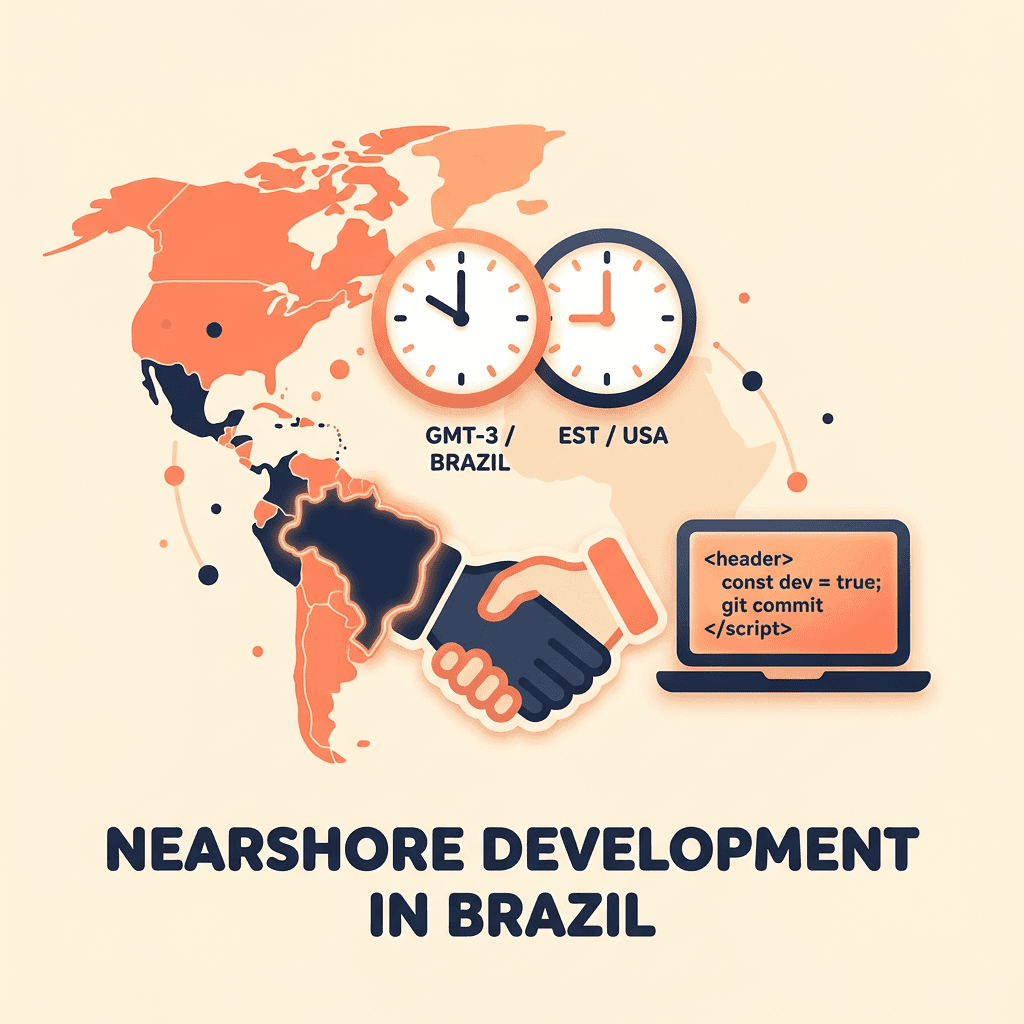
Hiring senior developers in the US is slow and expensive. Offshore teams on the other side of the world are cheaper, but the time difference turns every question into a 24-hour delay. Nearshore development sits in the middle: a team in a nearby time zone, at a lower cost, working during your business hours. Brazil has become one of the most popular nearshore destinations for US companies, and for good reasons.
Quick answer: nearshore software development in Brazil means working with a Brazilian team that shares most of your workday. Brasilia time is only 1 to 2 hours ahead of US Eastern Time, senior rates are usually 40% to 70% lower than US agency rates, and the country has a large, experienced developer community. The main risks (communication, quality, legal setup) are manageable with the right partner and contract.
What nearshore development means
| Model | Where the team is | Time zone gap to the US | Typical hourly rate |
|---|---|---|---|
| Onshore | United States | 0 to 3 hours | $80 to $150+ for developers; $120 to $250 for agencies |
| Nearshore | Latin America (Brazil, Mexico, Colombia, Argentina) | 0 to 5 hours | $35 to $80 for mid-level to senior |
| Offshore | Asia, Eastern Europe | 7 to 12+ hours | $25 to $80 |
Rates are approximate market ranges. The real difference between nearshore and offshore is not the price. It is how many hours a day your team and your vendor can actually talk.
Why US companies choose Brazil
1. Time zone overlap
Brazil's main business hub uses Brasilia time (UTC-3) all year, with no daylight saving time. That puts the team:
- 1 to 2 hours ahead of New York (ET);
- 2 to 3 hours ahead of Chicago (CT);
- 4 to 5 hours ahead of Los Angeles (PT).
For East Coast and Central companies, the workday overlaps almost completely. West Coast teams still get a solid morning block for standups, reviews and calls.
2. Cost
Senior Brazilian developers typically cost $50 to $80 per hour through a vendor, compared with $120 to $250 per hour at US agencies. For a detailed breakdown by seniority, see how much it costs to hire developers in Brazil.
3. Talent and experience
Brazil has one of the largest tech markets in Latin America, with a strong startup scene, large banks and fintechs, and a big open-source community. Many developers have worked for US and European clients and are used to agile processes, code reviews and written communication in English.
4. Cultural fit
Brazilian teams tend to communicate openly, push back when something does not make sense and work comfortably with US business habits. That reduces the "yes to everything" problem that hurts many offshore projects.
Risks and how to manage them
| Risk | How to reduce it |
|---|---|
| English level varies | Interview the people who will actually work on your project, not only the sales team |
| Uneven code quality | Ask for code samples, a paid pilot sprint and a clear testing process |
| Legal and IP | Sign a US-law contract that assigns all IP to you, with NDA and clear exit terms |
| Payments and taxes | Pay a company (vendor) in USD instead of hiring individuals directly, unless you have an employer of record |
| Dependency on the vendor | Keep code repositories, cloud accounts and app store accounts in your company's name |
| Turnover | Ask how the vendor replaces people and transfers knowledge |
Engagement models
- Staff augmentation: Brazilian developers join your team and follow your process. Best when you already have tech leadership. See IT staff augmentation services.
- Dedicated team: a full squad (developers, QA, design, project lead) works only on your product.
- Project-based: the vendor delivers a defined scope, such as an MVP, for a fixed or capped price. See MVP development for US startups.
Brazil vs other nearshore countries
| Country | Strengths | Points to check |
|---|---|---|
| Brazil | Large talent pool, strong in fintech, mobile, no-code and AI | Portuguese is the local language, so test English skills |
| Mexico | Same or close US time zones, strong English | Rates are often higher than in Brazil |
| Colombia | Growing market, good time zone overlap | Smaller senior talent pool |
| Argentina | Strong engineering tradition, competitive rates | Economic volatility can affect contracts |
Looking to compare vendors? See our list of the best nearshore development companies for US businesses.
How to choose a nearshore partner in Brazil
- Check portfolio and references from US clients.
- Interview the actual team members.
- Start with a paid pilot of 2 to 4 weeks.
- Confirm working hours and overlap with your team.
- Review the contract: IP ownership, NDA, termination, payment terms in USD.
- Ask how they handle testing, code reviews and deployments.
- Make sure all accounts and code stay in your name from day one.
For a general checklist, see how to choose an app development company.
FAQ
Is nearshore development in Brazil cheaper than offshore?
Not always. Some offshore markets have lower hourly rates. Brazil usually wins on total cost once you factor in fewer delays, less rework and easier communication.
Do Brazilian developers speak English?
Many do, especially those who work with international clients. Always test English in the interview, because the level varies.
Can I hire Brazilian developers directly?
You can hire contractors directly, but taxes, labor rules and payments get complicated. Working through a vendor or an employer of record is simpler and safer for most US companies.
How fast can a nearshore team start?
A vendor with a bench of available developers can often start within one to three weeks. Building a full dedicated team usually takes longer.
Who owns the code?
You should. Make IP assignment explicit in the contract and keep repositories in your company's accounts.
Conclusion
Nearshore development in Brazil gives US companies senior talent, real-time collaboration and lower costs than local hiring. The key is choosing a partner with a proven track record, a clear contract and a pilot before scaling.
Work with withnocode
withnocode is a Brazilian software company that works with US startups and businesses on custom software, no-code and AI projects, in your time zone. Learn about our nearshore staffing services.
Related Articles
ERP vs CRM: What's the Difference?
Understand the key differences between ERP and CRM systems: what each one does, their benefits, use cases, costs, the role of AI, and how to decide which system (or both) your business actually needs.
Custom CRM Development: Complete Guide
Everything businesses need to know about custom CRM development: what it is, benefits, essential features, AI-powered capabilities, costs, the development process, and how to decide if building a custom CRM is right for your company.