Custom CRM Development: Complete Guide
Everything businesses need to know about custom CRM development: what it is, benefits, essential features, AI-powered capabilities, costs, the development process, and how to decide if building a custom CRM is right for your company.
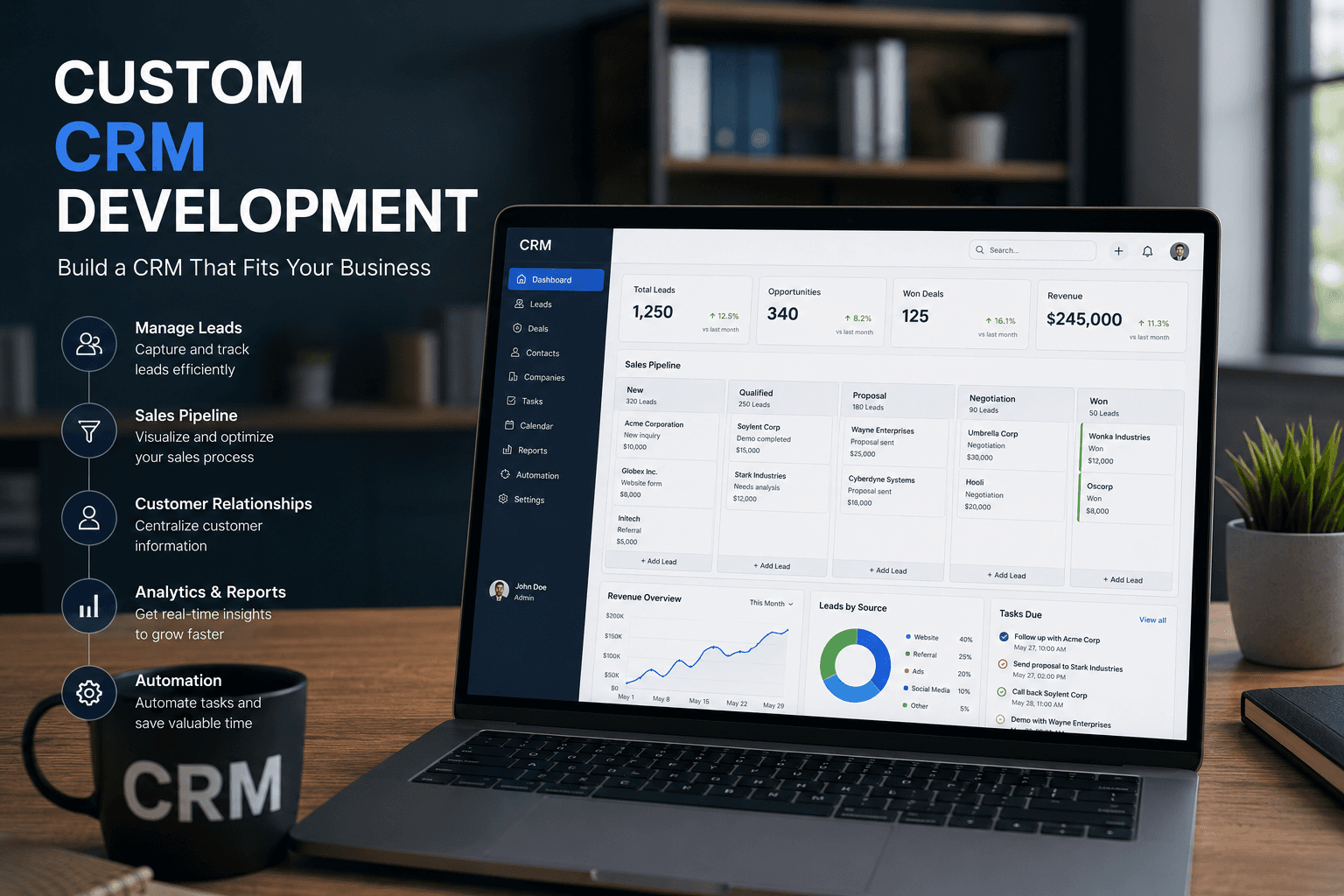
Managing customer relationships effectively is one of the biggest challenges companies face as they grow.
Many businesses start with spreadsheets, email chains, or generic CRM platforms. While these tools may work initially, they often become limitations as operations become more complex.
Leads get lost, sales processes become inconsistent, reporting becomes unreliable, and teams spend more time updating systems than closing deals.
This is where custom CRM development becomes a strategic investment.
A custom CRM allows businesses to build a platform tailored specifically to their sales process, customer journey, workflows, and business goals.
In this guide, you'll learn what a custom CRM is, when it makes sense to build one, its benefits, costs, features, development process, and how to determine whether it's the right solution for your company.
What Is a Custom CRM?
CRM stands for Customer Relationship Management.
A CRM system helps companies manage leads, customers, opportunities, communications, and sales activities from a centralized platform.
Unlike off-the-shelf CRM solutions, a custom CRM is developed specifically for your organization.
Instead of adapting your business to the software, the software is built around your business.
A custom CRM can include:
- Lead Management
- Sales Pipelines
- Customer Records
- Contract Management
- Proposal Tracking
- Customer Support
- Marketing Automation
- Reporting Dashboards
- AI Agents
- ERP Integrations
- WhatsApp Integrations
- Email Automation
The result is a platform designed specifically for your workflows. For a broader perspective on building tailored software, see our guide on bespoke software development.
Why Businesses Build Custom CRM Systems
Many companies start with platforms like Salesforce, HubSpot, Pipedrive, Zoho, or Monday.com.
These solutions are powerful, but over time businesses often encounter challenges such as:
- Expensive licensing costs
- Limited customization
- Complex workflows
- Unused features
- Third-party integration limitations
- Scaling costs per user
- Restricted automation capabilities
As a company grows, these limitations become increasingly expensive.
A custom CRM solves these issues by providing complete control over the platform.
Benefits of Custom CRM Development
Complete Process Alignment
Every business sells differently.
A software company has a different sales process than a law firm, healthcare provider, logistics company, or real estate agency.
Custom CRM development allows companies to create:
- Custom pipelines
- Unique workflows
- Industry-specific processes
- Specialized customer journeys
without compromise.
Increased Team Productivity
Sales representatives spend a significant amount of time performing administrative work.
A custom CRM can automate:
- Lead assignment
- Follow-up reminders
- Proposal generation
- Contract creation
- Customer onboarding
- Reporting
This allows teams to focus on revenue-generating activities.
Better Customer Experience
When customer information is centralized, every interaction becomes more personalized.
Teams gain instant access to:
- Customer history
- Previous conversations
- Contracts
- Purchases
- Support requests
This leads to stronger customer relationships and higher retention rates.
Lower Long-Term Costs
Many businesses underestimate the cumulative cost of SaaS subscriptions.
Monthly CRM fees often increase based on:
- Number of users
- Storage usage
- Automation limits
- API access
- Premium features
For larger organizations, a custom CRM can become more cost-effective over time.
Competitive Advantage
A custom CRM can incorporate workflows and automation that competitors cannot easily replicate.
Technology becomes a business asset rather than a generic tool.
Essential Features of a Custom CRM
Lead Management
Capture leads from multiple sources:
- Website forms
- Landing pages
- Google Ads
- LinkedIn Ads
- Meta Ads
- Referrals
All leads automatically enter the sales pipeline.
Sales Pipeline Management
Visualize opportunities through each stage of the sales process.
Example:
- New Lead
- Qualified
- Discovery Call
- Proposal Sent
- Negotiation
- Closed Won
- Closed Lost
Each company can customize these stages.
Customer Management
Store and organize customer information including:
- Contact details
- Purchase history
- Documents
- Contracts
- Notes
- Communication history
Proposal and Contract Tracking
Generate, send, and track proposals directly from the CRM.
Monitor:
- Proposal status
- Contract approvals
- Signature progress
- Renewal dates
Reporting and Analytics
Custom dashboards provide visibility into:
- Revenue forecasts
- Conversion rates
- Sales performance
- Customer acquisition costs
- Sales cycle duration
These insights support data-driven decision-making.
AI-Powered CRM Systems
Artificial Intelligence is transforming CRM software.
Modern custom CRM platforms increasingly include AI-driven capabilities.
AI Sales Agents
AI agents can:
- Qualify leads
- Schedule meetings
- Answer common questions
- Collect customer information
- Route inquiries
automatically.
Lead Scoring
AI can identify which leads are most likely to convert.
This allows sales teams to prioritize opportunities effectively.
Automated Meeting Summaries
AI can generate summaries from:
- Calls
- Meetings
- Sales conversations
- Customer support interactions
reducing manual documentation.
Predictive Analytics
AI helps forecast:
- Future revenue
- Churn risks
- Customer behavior
- Sales performance
providing strategic insights.
Custom CRM vs Off-the-Shelf CRM
Off-the-Shelf CRM
Examples include:
- Salesforce
- HubSpot
- Zoho CRM
- Pipedrive
- Monday Sales CRM
| Aspect | Off-the-Shelf CRM | Custom CRM |
|---|---|---|
| Setup Time | Faster | Development timeline |
| Initial Investment | Lower | Higher upfront |
| Customization | Limited | Complete |
| Scalability | Feature limitations | Unlimited |
| Workflows | Generic | Business-specific |
| Integrations | Existing ecosystem | Custom integrations |
| Ownership | Vendor dependency | Full ownership |
| Long-Term Cost | Ongoing subscriptions | More predictable |
For growing businesses with unique requirements, custom CRM systems often deliver greater long-term value.
Industries That Benefit from Custom CRM Development
Real Estate
Manage properties, leads, buyers, sellers, and transactions.
Healthcare
Patient management, scheduling, communication, and reporting.
Legal Services
Track consultations, cases, contracts, and client interactions.
Financial Services
Manage prospects, portfolios, and compliance workflows.
SaaS Companies
Handle product trials, onboarding, subscriptions, and customer success.
B2B Sales Organizations
Support complex sales cycles involving multiple stakeholders.
CRM Integrations
Modern CRMs rarely operate in isolation.
Custom CRM systems can integrate with:
- ERP Systems
- Accounting Software
- Payment Gateways
- Email Platforms
- Marketing Tools
- WhatsApp Business
- Stripe
- HubSpot
- Salesforce
- Custom APIs
Integration eliminates data silos and improves efficiency. Learn more in our guide on business process automation.
The Custom CRM Development Process
1. Discovery and Requirements Gathering
Understand current workflows, pain points, and business objectives.
2. Solution Architecture
Design system structure, modules, permissions, and integrations.
3. UI/UX Design
Create intuitive interfaces that maximize user adoption.
4. Development
Build frontend, backend, automation workflows, and integrations.
5. Testing
Validate functionality, performance, and security.
6. Deployment
Launch the system and train users.
7. Continuous Improvement
Add features and enhancements as business needs evolve.
How Much Does Custom CRM Development Cost?
The cost depends on several factors:
- Number of users
- Modules required
- Integrations
- AI features
- Security requirements
- Reporting complexity
Typical investment ranges:
| Project Type | Estimated Cost |
|---|---|
| Basic CRM | $10,000 – $25,000 |
| Mid-Market CRM | $25,000 – $75,000 |
| Enterprise CRM | $75,000 – $250,000+ |
Every project should be evaluated individually. For a deeper breakdown of development pricing, read how much custom software development costs.
Signs Your Business Needs a Custom CRM
You may need a custom CRM if:
- Your team relies heavily on spreadsheets
- Your current CRM limits your workflows
- You use multiple disconnected tools
- Reporting is difficult or inaccurate
- Your subscription costs keep increasing
- You need advanced automation
- You want AI-powered sales processes
- Your business has unique requirements
If several of these apply, it may be time to explore whether your business needs custom software.
Why Choose Withnocode for Custom CRM Development?
Withnocode specializes in building custom business software designed for growth.
Our team develops scalable CRM systems with:
- Modern architecture
- AI integrations
- Advanced automation
- Enterprise-grade security
- Custom dashboards
- ERP integrations
- Mobile-ready experiences
We focus on creating CRM platforms that improve efficiency, increase sales performance, and scale with your business.
Frequently Asked Questions
How long does custom CRM development take?
Most projects take between 6 and 16 weeks depending on complexity.
Can a custom CRM integrate with existing systems?
Yes. Most CRM projects include integrations with accounting software, ERP systems, payment providers, marketing platforms, and APIs.
Can AI be added to a CRM?
Absolutely. AI agents, predictive analytics, automated reporting, and lead qualification are among the most popular features today.
Is custom CRM development worth it?
For businesses with unique workflows, growing teams, and complex operations, a custom CRM often delivers significant long-term ROI.
Conclusion
A CRM is far more than a contact database.
When designed correctly, it becomes the operational backbone of your sales and customer management processes.
Custom CRM development allows businesses to build software that aligns perfectly with their operations, improves productivity, automates repetitive tasks, and creates a better customer experience.
As organizations scale, owning a CRM tailored to their unique workflows can become a major competitive advantage.
Ready to Build Your Custom CRM?
Withnocode builds scalable, AI-powered CRM systems tailored to your sales process, workflows, and integrations. Schedule a free consultation to discover how a custom CRM can boost productivity and grow your revenue.
Related Articles
ERP vs CRM: What's the Difference?
Understand the key differences between ERP and CRM systems: what each one does, their benefits, use cases, costs, the role of AI, and how to decide which system (or both) your business actually needs.

Bespoke Software Development: Complete Guide
Everything businesses need to know about bespoke software development, from benefits and costs to the development process and choosing the right technology partner.