RAG vs Fine-Tuning: Which Is Better for Enterprise AI?
Compare RAG and Fine-Tuning for enterprise AI systems. Learn key differences, when to use each approach, cost implications, and how hybrid architectures maximize AI performance.
Last updated: May 2026
As businesses increasingly adopt AI systems powered by Large Language Models (LLMs), one question appears repeatedly:
Should we use RAG or Fine-Tuning?
Both approaches improve AI performance, but they solve very different problems.
Understanding the difference between Retrieval-Augmented Generation (RAG) and Fine-Tuning is critical for building scalable, accurate, and cost-effective enterprise AI systems.
In this guide, we'll break down:
- What RAG is
- What Fine-Tuning is
- Key differences
- Advantages and limitations
- Enterprise use cases
- Cost considerations
- Security implications
- When businesses should use each approach
Many companies investing in enterprise AI solutions eventually discover that choosing the right architecture is more important than choosing the model itself.
What Is RAG?
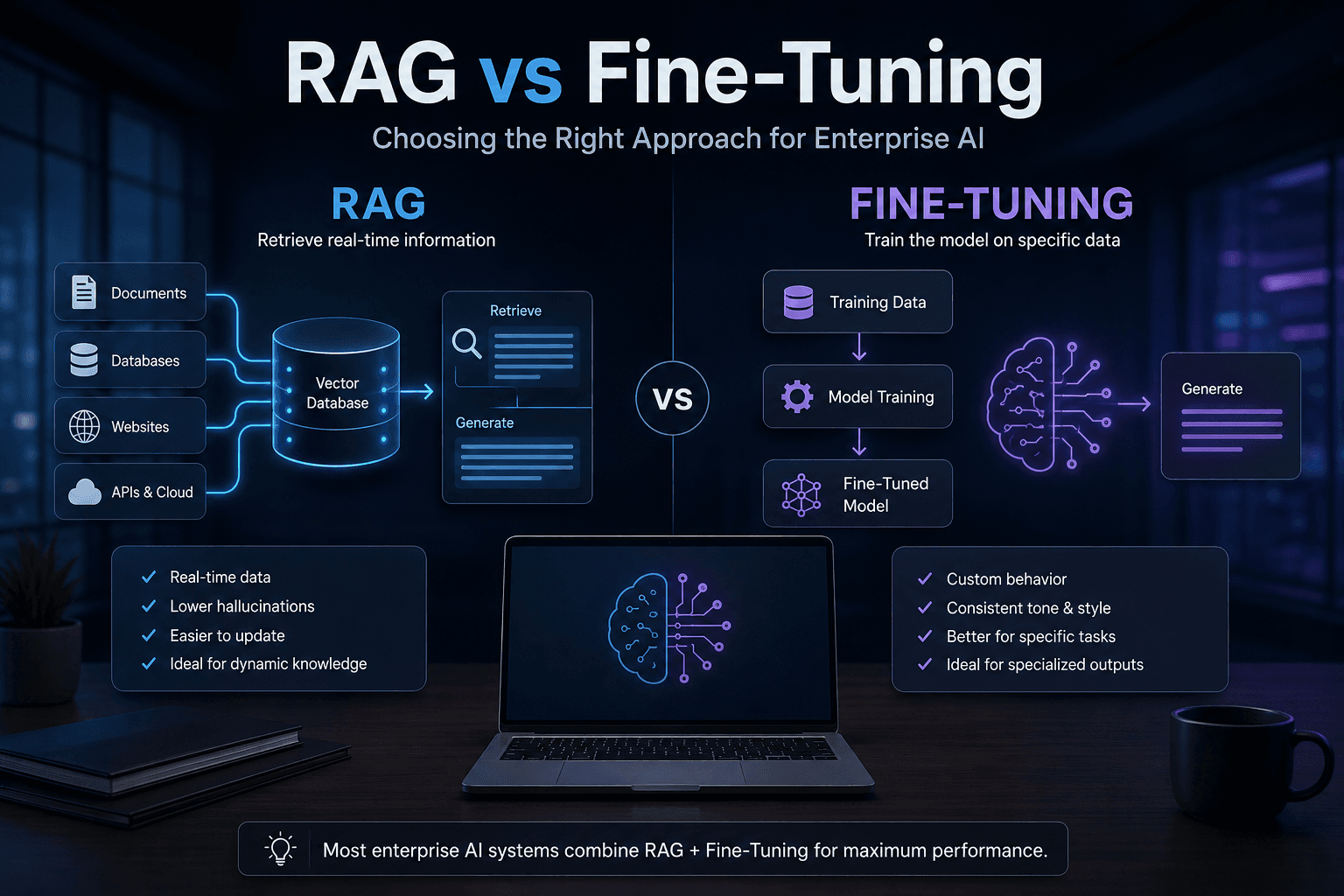
Retrieval-Augmented Generation (RAG) is an AI architecture that retrieves external information before generating responses.
Instead of relying only on the model's training knowledge, the AI searches:
- PDFs
- Databases
- Internal documents
- APIs
- Knowledge bases
- CRM systems
- Cloud storage
The retrieved information is then injected into the LLM's context window.
This allows AI systems to generate answers using real-time business data.
If you're new to the concept, read our complete guide on What Is RAG?.
What Is Fine-Tuning?
Fine-tuning is the process of training an existing AI model on additional custom data.
Instead of retrieving external information dynamically, the model itself learns:
- Writing style
- Tone
- Behaviors
- Domain-specific patterns
- Specialized outputs
During fine-tuning:
- Model weights are adjusted
- Training data is processed
- The model behavior changes permanently
Businesses often use fine-tuning to create:
- Specialized assistants
- Brand-specific AI
- Industry-focused AI systems
The Core Difference
The biggest difference is simple:
- RAG retrieves information.
- Fine-tuning changes behavior.
RAG helps the AI access knowledge.
Fine-tuning helps the AI behave differently.
How RAG Works
A RAG system:
- Receives a user query
- Searches external knowledge sources
- Retrieves relevant information
- Injects the information into the prompt
- Generates a contextual response
This makes RAG ideal for:
- Dynamic information
- Frequently changing data
- Enterprise knowledge systems
Businesses implementing RAG development services typically prioritize accuracy, scalability, and real-time information access.
How Fine-Tuning Works
Fine-tuning modifies the underlying model itself.
The process involves:
- Preparing training datasets
- Formatting instruction pairs
- Training the model
- Validating performance
- Deploying the updated model
This changes how the model responds permanently.
Fine-tuning is especially useful when businesses need:
- Consistent tone
- Specialized formatting
- Domain-specific language
- Structured outputs
RAG vs Fine-Tuning Comparison
| Feature | RAG | Fine-Tuning |
|---|---|---|
| Purpose | Retrieve information | Modify behavior |
| Real-time data | Yes | No |
| Dynamic updates | Easy | Difficult |
| Cost | Lower | Higher |
| Deployment speed | Fast | Slower |
| Hallucination reduction | Strong | Moderate |
| Internal company data | Excellent | Limited |
| Writing style customization | Limited | Excellent |
| Maintenance | Easier | More complex |
| Enterprise scalability | High | Medium |
When Businesses Should Use RAG
RAG is the best choice when companies need:
- Access to internal knowledge
- Real-time information
- Secure document retrieval
- Enterprise search
- AI copilots
- Knowledge management systems
Common enterprise RAG use cases include:
- Customer support AI
- Legal document retrieval
- Internal employee assistants
- AI knowledge bases
- Contract analysis systems
When Businesses Should Use Fine-Tuning
Fine-tuning works best when companies need:
- Consistent brand voice
- Specialized formatting
- Custom behaviors
- Industry-specific communication
- Structured response patterns
Examples include:
- Financial report generation
- Medical terminology adaptation
- Legal writing styles
- Customer service tone optimization
Why RAG Is Dominating Enterprise AI
In recent years, RAG has become the preferred architecture for enterprise AI.
Why?
Because businesses care about:
- Accurate information
- Updated data
- Internal knowledge access
- Faster implementation
- Lower operational costs
Most companies do not need to retrain models constantly.
They simply need AI systems connected to their business data.
This is why enterprise AI systems increasingly use RAG as their foundational architecture.
The Problem With Fine-Tuning for Knowledge
A common misconception is:
"We can fine-tune the model with our documents."
Technically possible? Yes.
Recommended? Usually not.
Why?
Because:
- Retraining is expensive
- Knowledge changes constantly
- Updates require retraining
- Large datasets increase complexity
For dynamic business data, RAG is almost always more practical.
Can RAG and Fine-Tuning Work Together?
Absolutely.
In fact, many advanced AI systems combine both approaches.
Example Hybrid Architecture
RAG handles:
- Knowledge retrieval
- Real-time data
- Internal documents
Fine-tuning handles:
- Tone
- Formatting
- Domain-specific behavior
This creates highly capable enterprise AI systems.
Cost Comparison
RAG Costs
RAG systems typically require:
- Embedding generation
- Vector databases
- Retrieval infrastructure
- LLM inference
However:
- Updates are simple
- Scaling is easier
- Maintenance costs are lower
Fine-Tuning Costs
Fine-tuning often requires:
- GPU training
- Dataset preparation
- Evaluation pipelines
- Retraining cycles
This increases:
- Infrastructure complexity
- Engineering requirements
- Operational costs
Security Considerations
Enterprise AI security is critical.
RAG Security Advantages
Private RAG systems can:
- Restrict document access
- Enforce permissions
- Operate in private environments
- Support compliance policies
This makes RAG highly attractive for:
- Legal
- Healthcare
- Finance
- Enterprise operations
Performance Considerations
RAG Strengths
- Fresh information
- Lower hallucinations
- Easier updates
- Better enterprise scalability
Fine-Tuning Strengths
- Better consistency
- Specialized outputs
- Custom communication styles
- Improved task-specific behavior
The Rise of Agentic RAG
One of the fastest-growing trends is Agentic RAG.
In this architecture:
- AI agents retrieve information dynamically
- Use tools
- Execute workflows
- Make contextual decisions
This combines:
- RAG
- AI agents
- Automation systems
Modern AI agent systems are increasingly adopting agentic architectures for operational efficiency.
Which One Should Your Business Choose?
Choose RAG if you need:
- Enterprise knowledge access
- Real-time information
- Internal document retrieval
- AI search systems
- Customer support AI
Choose Fine-Tuning if you need:
- Specialized communication
- Custom AI behaviors
- Consistent outputs
- Brand voice adaptation
Choose Both if you need:
- Enterprise-scale AI systems
- Highly optimized workflows
- Advanced AI agents
- Complex automation platforms
Final Thoughts
RAG and Fine-Tuning are not competitors.
They are complementary technologies solving different problems.
RAG enables AI systems to access accurate, real-time business information.
Fine-tuning enables AI systems to behave in specialized ways.
For most enterprise use cases, RAG is becoming the default foundation because it offers:
- Faster deployment
- Lower cost
- Better scalability
- Improved accuracy
- Easier maintenance
As enterprise AI adoption accelerates, the most successful organizations will combine RAG, AI agents, automation, fine-tuning, and private AI infrastructure into unified intelligent systems capable of transforming business operations.
Final Thoughts
Understanding when to use RAG versus fine-tuning is essential for building cost-effective, scalable enterprise AI. Most modern AI systems will combine both approaches along with AI agents to create powerful intelligent workflows. If your organization is planning custom AI implementation, investing in professional RAG development services can significantly accelerate deployment and maximize AI performance across your business operations.
Related Articles
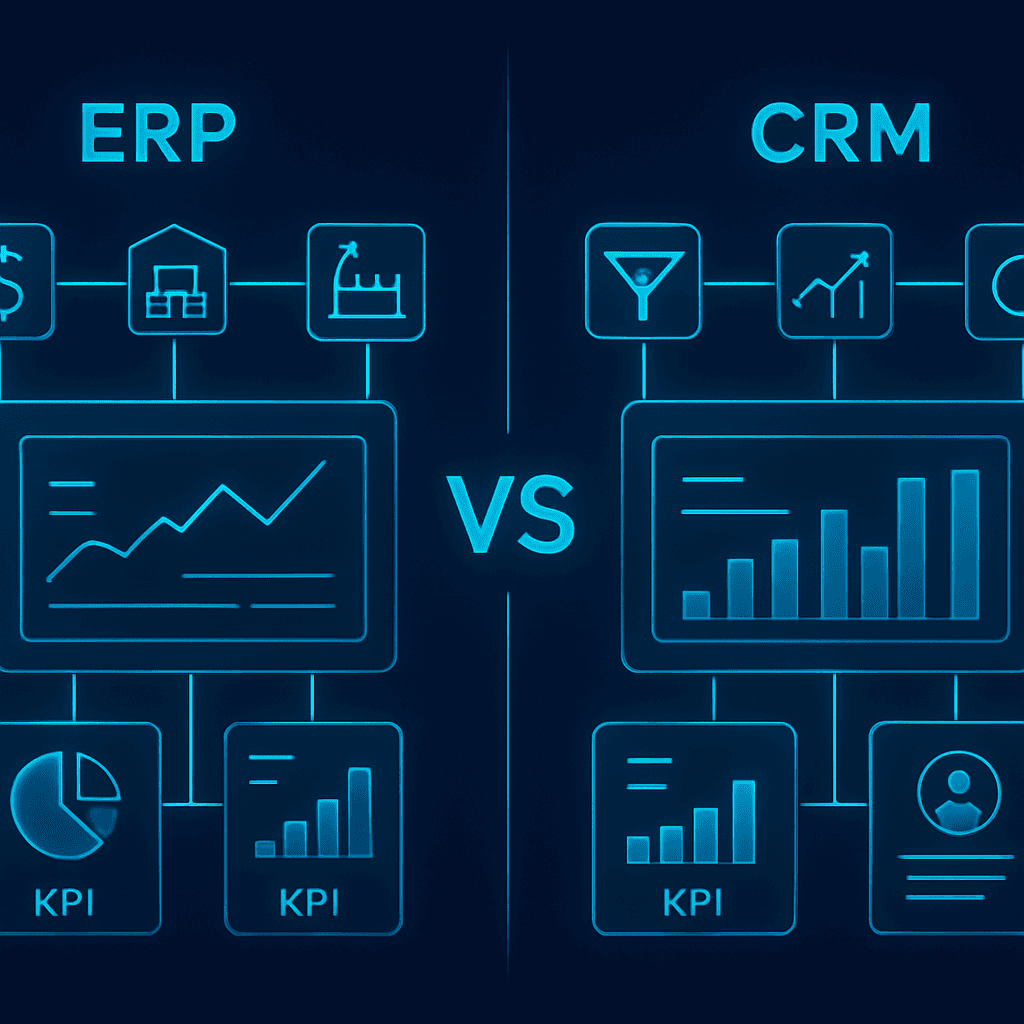
ERP vs CRM: What's the Difference?
Understand the key differences between ERP and CRM systems: what each one does, their benefits, use cases, costs, the role of AI, and how to decide which system (or both) your business actually needs.
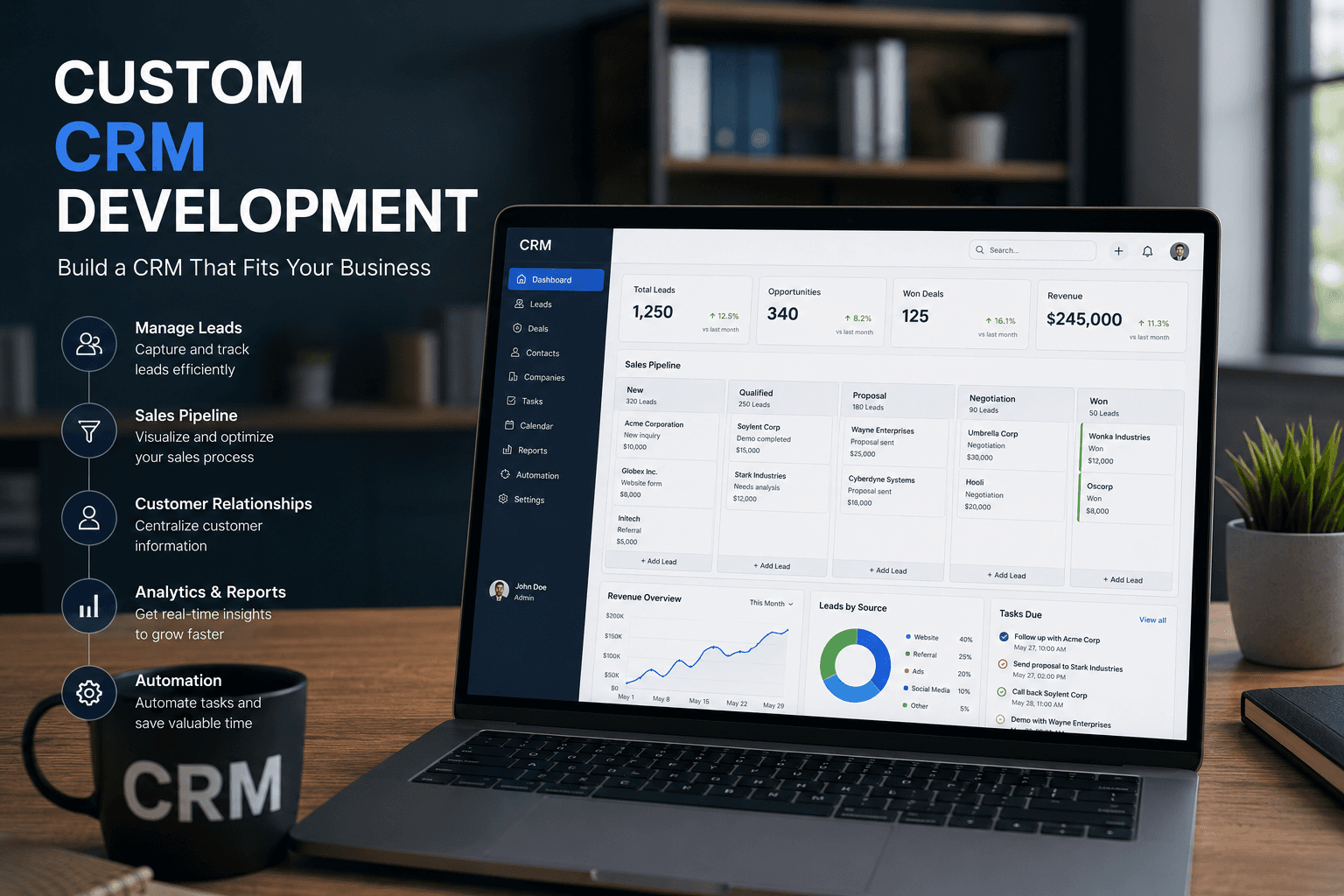
Custom CRM Development: Complete Guide
Everything businesses need to know about custom CRM development: what it is, benefits, essential features, AI-powered capabilities, costs, the development process, and how to decide if building a custom CRM is right for your company.