What Is RAG? A Complete Guide to Retrieval-Augmented Generation for Businesses
Learn how Retrieval-Augmented Generation enables AI systems to access your company's private data in real-time. Complete guide on RAG architecture, benefits, use cases, and implementation.
Last updated: May 2026
Artificial Intelligence has changed how companies search, organize, and interact with information. But despite the massive progress in Large Language Models (LLMs) like GPT-5, Claude, and Gemini, businesses still face a major challenge:
AI models do not naturally know your company's internal data.
This is where Retrieval-Augmented Generation (RAG) becomes one of the most important technologies in modern enterprise AI.
RAG allows AI systems to retrieve information from your company's documents, databases, PDFs, knowledge bases, and internal systems before generating responses. Instead of relying only on the model's training data, the AI can answer using your real business information in real time.
Businesses are increasingly investing in RAG development services to create intelligent AI systems connected to their internal knowledge and workflows.
What Is RAG?
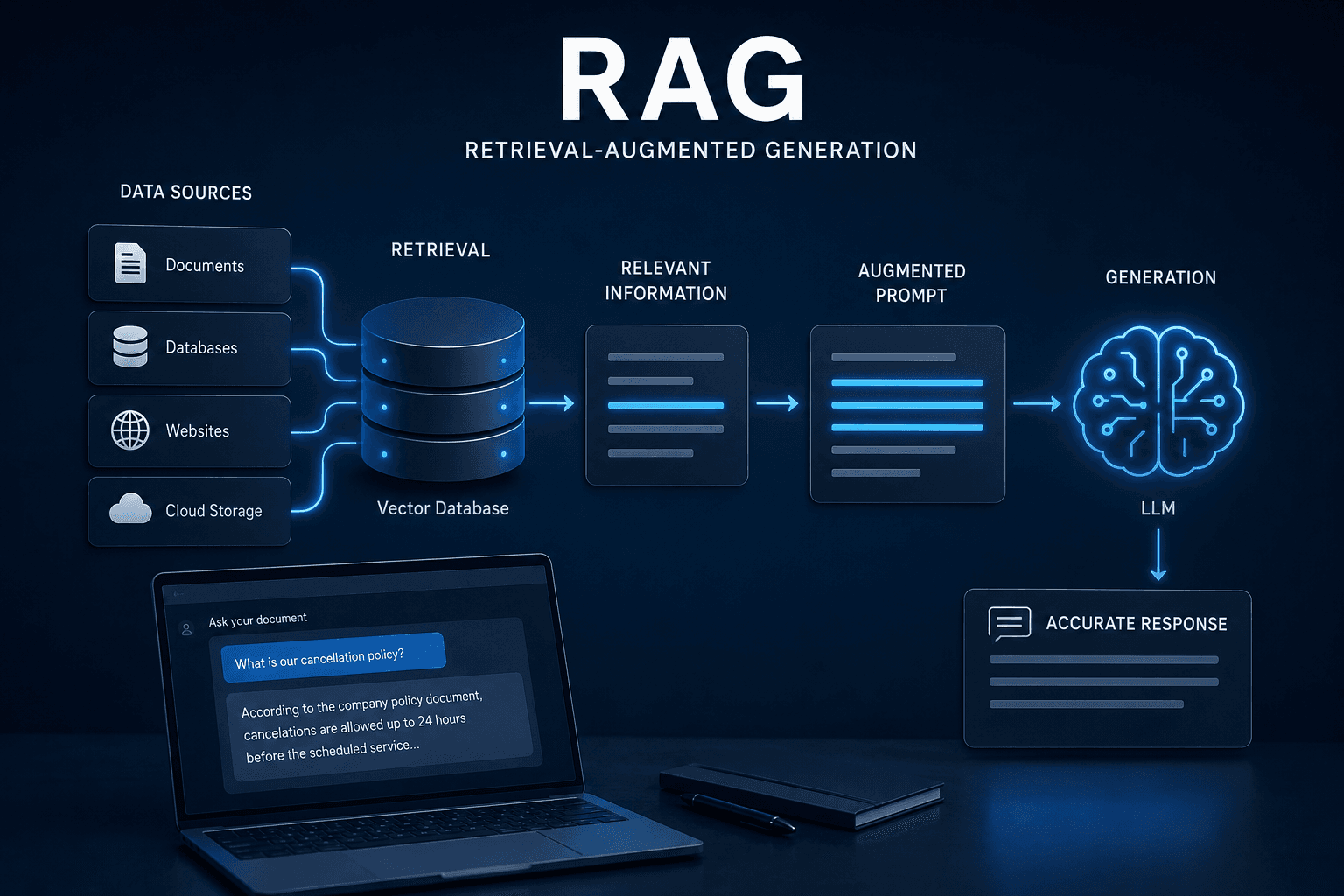
Retrieval-Augmented Generation (RAG) is an AI architecture that combines:
- Information retrieval
- Large Language Models (LLMs)
The system first retrieves relevant information from external data sources and then uses that information to generate accurate responses.
Instead of depending only on what the model learned during training, RAG gives the AI access to:
- Internal company documents
- PDFs
- Contracts
- Wikis
- Databases
- CRM data
- Support documentation
- Knowledge bases
- APIs
- Cloud storage systems
This makes the AI significantly more reliable and useful for businesses building modern enterprise AI solutions.
Why Traditional AI Models Have Limitations
LLMs are powerful, but they have several important limitations.
1. No Real-Time Knowledge
Most AI models only know information available during training.
They may not know:
- Your latest company policies
- Internal documentation
- Recent contracts
- Product updates
- Private business data
2. Hallucinations
AI models sometimes generate incorrect or fabricated answers confidently.
This becomes dangerous in:
- Legal
- Finance
- Healthcare
- Enterprise support
3. No Access to Internal Data
A normal chatbot cannot naturally search:
- Google Drive
- SharePoint
- Notion
- CRMs
- Internal databases
Without RAG, the model operates in isolation.
This is why companies increasingly combine RAG with AI agents capable of interacting with enterprise systems and workflows.
How RAG Works
RAG systems follow a multi-step pipeline.
Step 1: Data Ingestion
The system collects data from various sources:
- PDFs
- Word documents
- Databases
- Websites
- APIs
- Cloud storage
- Internal tools
This information is then processed and indexed.
Step 2: Chunking
Large documents are divided into smaller pieces called chunks.
For example:
- A 100-page PDF may become hundreds of text chunks.
- Each chunk contains manageable context for retrieval.
Proper chunking is critical for RAG quality.
Step 3: Embeddings
Each chunk is converted into a numerical vector representation called an embedding.
Embeddings allow AI systems to understand semantic meaning instead of only keywords.
For example:
- "Customer refund policy"
- "How refunds work"
May produce similar embeddings even with different wording.
Step 4: Vector Database Storage
The embeddings are stored in a vector database such as:
- Pinecone
- Weaviate
- Qdrant
- Chroma
- Milvus
These databases enable semantic search at scale.
Step 5: User Query
When a user asks a question:
"What is our cancellation policy?"
The system converts the query into an embedding.
Step 6: Retrieval
The vector database searches for the most relevant chunks based on semantic similarity.
Instead of keyword matching, it retrieves meaning-based results.
Step 7: Augmented Generation
The retrieved content is injected into the AI model's context window.
The LLM then generates a response using:
- The retrieved documents
- The user query
- Its natural language capabilities
This dramatically improves accuracy.
Simple Example of RAG
Imagine a law firm with thousands of contracts and legal documents.
Without RAG:
The AI does not know the firm's cases or clauses.
With RAG:
- The AI searches the firm's legal database
- Retrieves relevant clauses
- Generates contextual legal answers
This enables:
- Faster research
- Contract analysis
- Internal legal copilots
- Knowledge automation
Many organizations are now implementing Legal AI solutions powered by RAG systems.
Benefits of RAG for Businesses
1. Access to Private Company Data
RAG enables AI systems to work with internal business knowledge.
This is essential for enterprise adoption.
2. Reduced Hallucinations
Because responses are grounded in retrieved documents, hallucinations decrease significantly.
3. Real-Time Information
Unlike static model training, RAG systems can continuously access updated information.
4. Lower Cost Than Fine-Tuning
In many cases, RAG is cheaper and faster than retraining models.
To better understand the differences, read our comparison of RAG vs Fine-Tuning.
5. Faster Deployment
Businesses can deploy RAG systems quickly without training custom models from scratch.
6. Better Enterprise Security
Private RAG systems can run:
- On-premise
- In private cloud environments
- With secure document access controls
This is especially important for businesses investing in secure enterprise AI systems.
RAG vs Fine-Tuning
Many businesses confuse RAG with fine-tuning.
They solve different problems.
| RAG | Fine-Tuning |
|---|---|
| Retrieves external information | Changes model behavior |
| Best for dynamic knowledge | Best for style/behavior customization |
| Faster to update | Requires retraining |
| Lower cost | More expensive |
| Excellent for enterprise documents | Better for specialized outputs |
In practice, many advanced AI systems combine both.
Common Enterprise Use Cases
Customer Support
AI systems can answer questions using:
- Knowledge bases
- Documentation
- Product manuals
Legal AI
RAG is extremely valuable for:
- Contract review
- Legal research
- Clause extraction
- Compliance systems
Internal Company Copilots
Employees can search internal documentation conversationally.
Healthcare
Medical organizations use RAG for:
- Clinical knowledge retrieval
- Documentation support
- Research systems
Sales & CRM
AI can retrieve:
- Customer history
- Product details
- Pricing policies
Best Tech Stack for RAG
A modern RAG stack often includes:
LLMs
- GPT-5
- Claude
- Gemini
Frameworks
- LangChain
- LlamaIndex
- Haystack
Vector Databases
- Pinecone
- Weaviate
- Qdrant
- Chroma
Embedding Models
- OpenAI Embeddings
- Voyage AI
- Cohere Embeddings
Challenges of RAG
Despite its advantages, RAG systems also have challenges.
Poor Chunking
Bad chunking reduces retrieval quality.
Weak Retrieval
Low-quality embeddings or search strategies impact accuracy.
Context Window Limits
LLMs still have token limitations.
Data Security
Enterprise deployments require:
- Access controls
- Encryption
- Compliance policies
Advanced RAG Architectures
Modern enterprise systems increasingly use:
- Hybrid search
- Multi-step retrieval
- Agentic RAG
- Graph RAG
- Multi-agent orchestration
- Reranking pipelines
These improve accuracy and scalability.
The Future of RAG
RAG is rapidly becoming foundational infrastructure for enterprise AI.
As businesses demand:
- Reliable AI
- Secure AI
- Private AI
- Real-time knowledge access
RAG systems will continue evolving into:
- AI copilots
- Autonomous agents
- Enterprise knowledge systems
The companies adopting RAG today are building the next generation of intelligent operations.
Final Thoughts
Retrieval-Augmented Generation is one of the most important developments in modern AI. Instead of relying solely on pretrained knowledge, RAG allows businesses to create AI systems connected to their real operational data. This unlocks smarter enterprise AI, better automation, accurate internal assistants, secure knowledge systems, and scalable AI workflows. As enterprise AI adoption accelerates, RAG is quickly becoming a core layer of intelligent business infrastructure. If your organization is exploring enterprise AI adoption, investing in professional RAG development services can significantly accelerate deployment, improve security, and maximize business value.
Related Articles
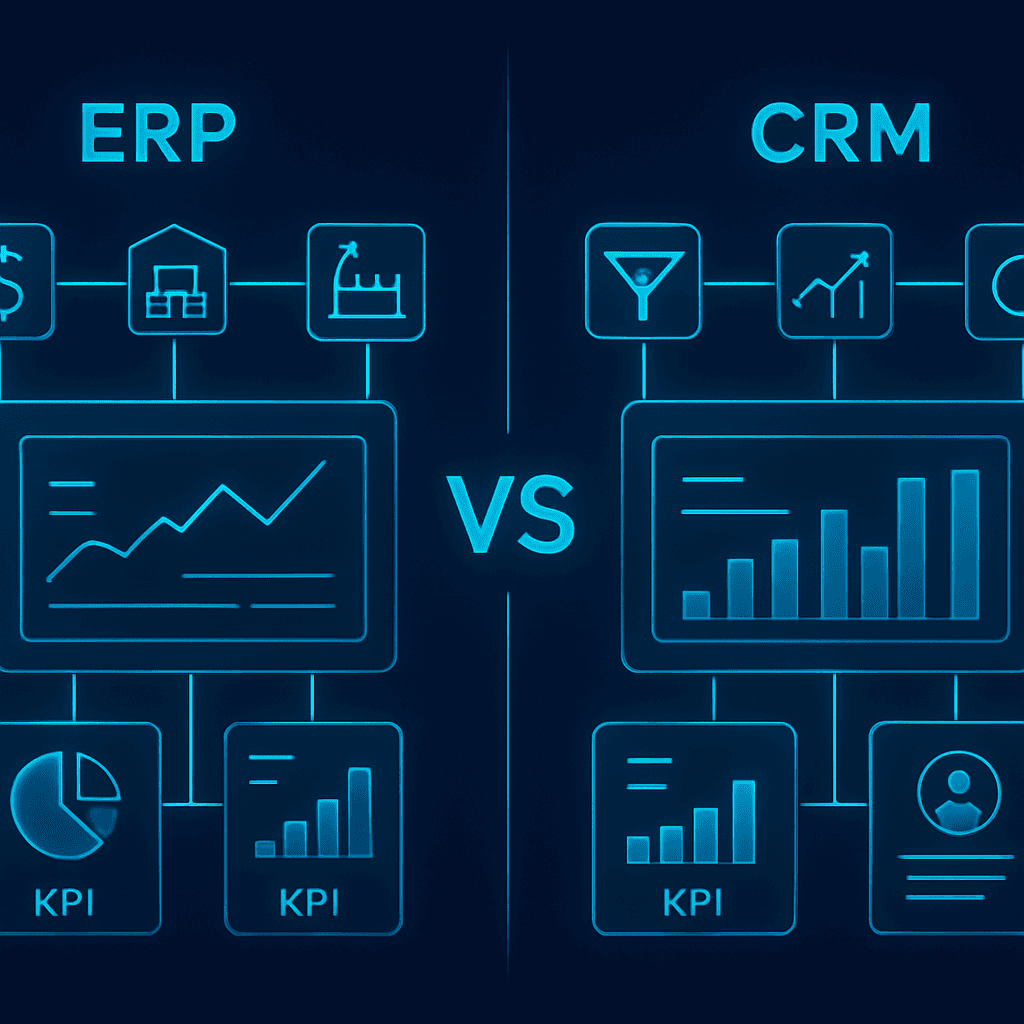
ERP vs CRM: What's the Difference?
Understand the key differences between ERP and CRM systems: what each one does, their benefits, use cases, costs, the role of AI, and how to decide which system (or both) your business actually needs.
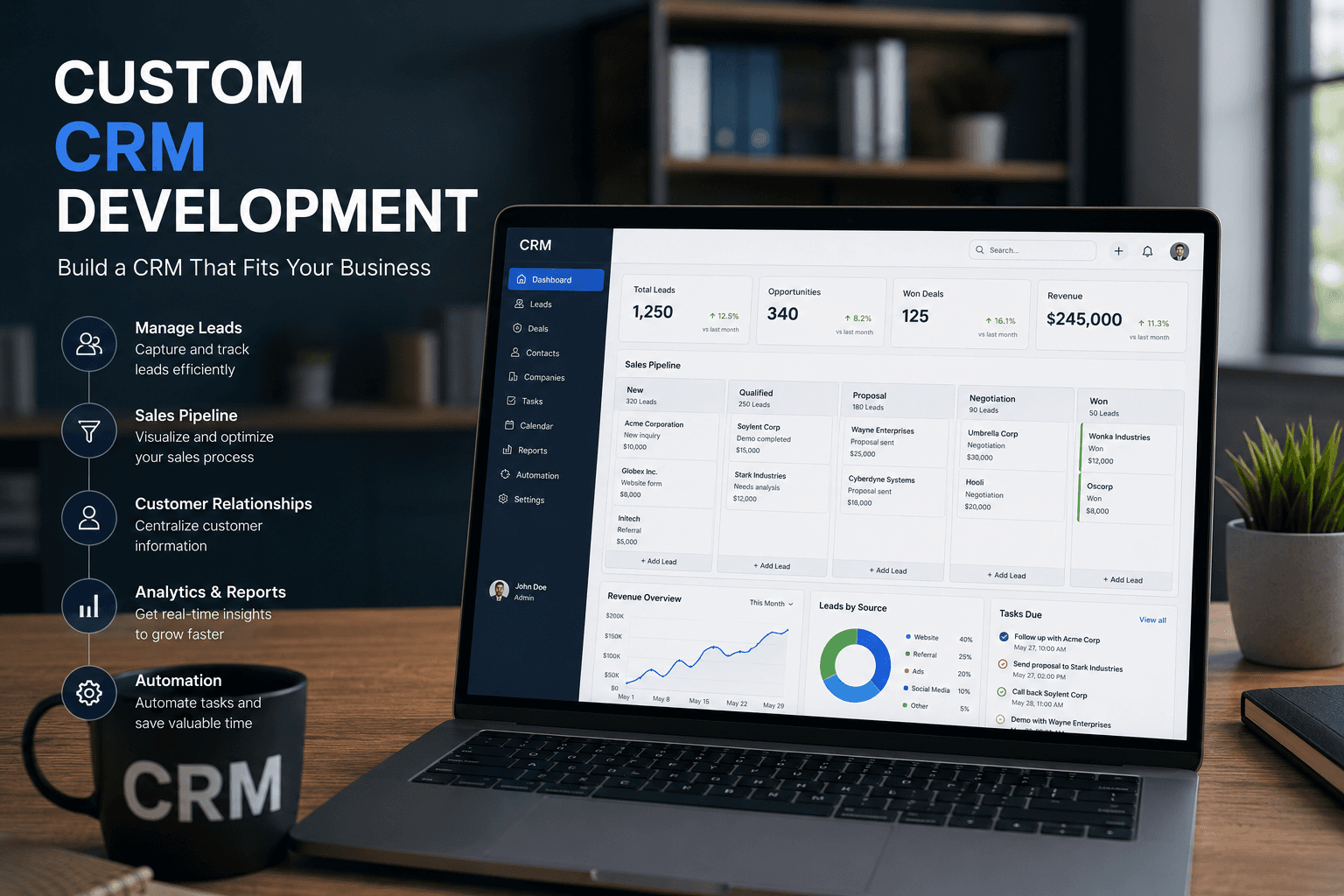
Custom CRM Development: Complete Guide
Everything businesses need to know about custom CRM development: what it is, benefits, essential features, AI-powered capabilities, costs, the development process, and how to decide if building a custom CRM is right for your company.