Vibe Coding vs Traditional Development
Compare vibe coding and traditional development approaches. Understand the tradeoffs in speed, cost, scalability, security, and maintenance to choose the right strategy for your product.
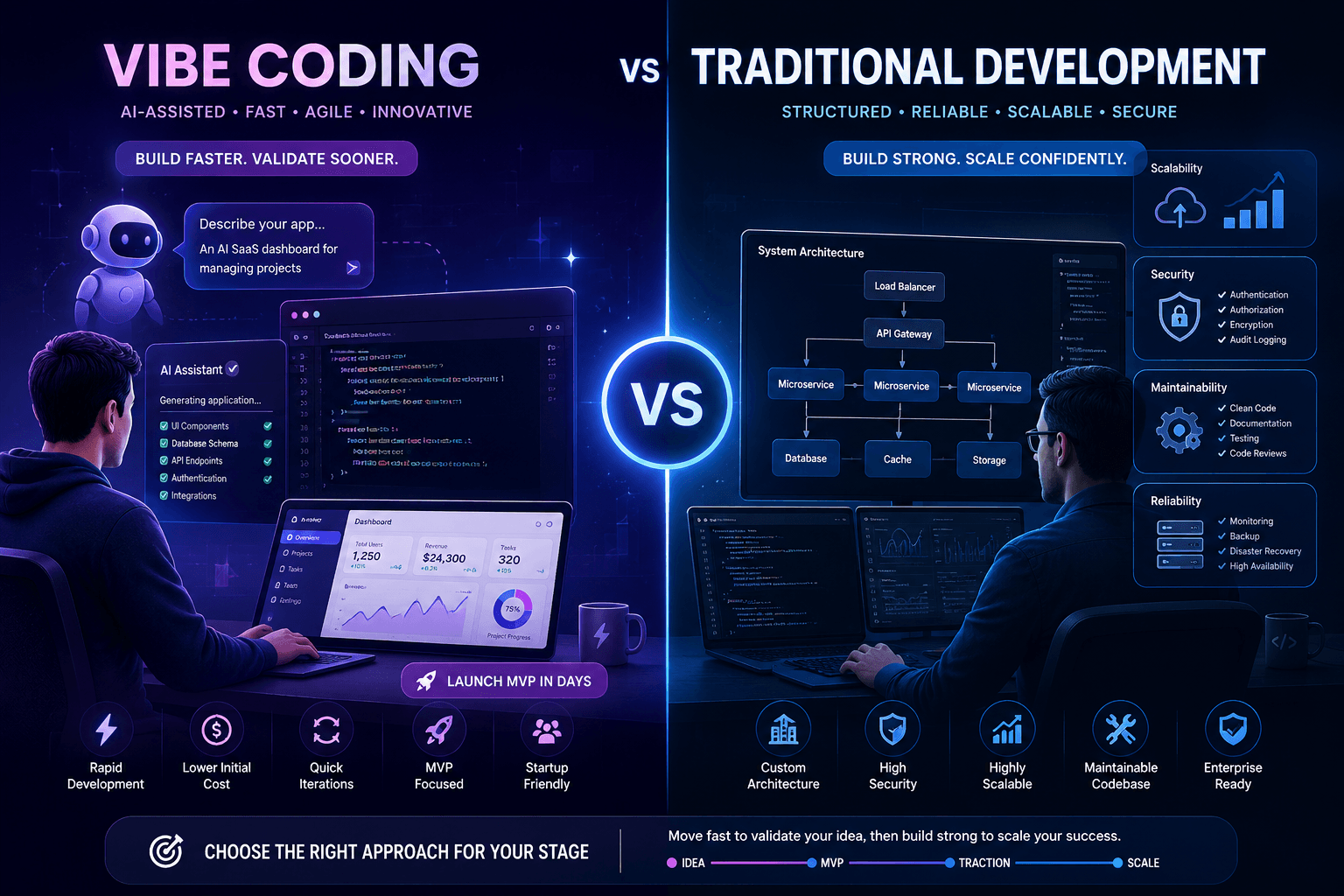
Artificial intelligence is transforming software development.
Today, founders can build applications using AI-powered tools in a matter of days rather than months. Platforms like Lovable, Bolt, Replit, Cursor, and other AI-assisted development environments have dramatically lowered the barriers to software creation.
This new approach, commonly known as vibe coding, is helping startups launch products faster than ever before.
At the same time, traditional software development remains the foundation behind many of the world's most scalable, secure, and reliable applications.
So which approach is better?
The answer depends on your business goals, growth plans, budget, and technical requirements.
In this guide, we'll compare vibe coding and traditional development across the factors that matter most: speed, cost, scalability, maintenance, security, and long-term business value.
What Is Vibe Coding?
Vibe coding refers to building software primarily through AI-assisted development tools.
Instead of manually writing every line of code, founders and developers use prompts to generate:
- User interfaces
- APIs
- Business logic
- Database structures
- Authentication systems
- Third-party integrations
The goal is simple: build software faster.
Vibe coding has become especially popular among:
- Startups
- Solo founders
- Product teams
- Non-technical entrepreneurs
- Companies validating new ideas
The primary advantage is speed.
Products that previously required months of development can often be launched in weeks or even days.
What Is Traditional Development?
Traditional software development follows a more structured engineering process.
Applications are designed, built, tested, and maintained according to established software engineering principles.
This approach typically includes:
- System architecture planning
- Manual coding
- Technical documentation
- Code reviews
- Security assessments
- Quality assurance testing
- Long-term maintenance planning
Many growing organizations invest in Custom Software Development Services when building software that must support long-term business growth.
While traditional development usually requires more time upfront, it often creates a stronger technical foundation.
Speed: Vibe Coding Has a Clear Advantage
One of the biggest reasons founders adopt vibe coding is speed.
Vibe Coding
Advantages:
- Rapid MVP creation
- Faster iterations
- Immediate prototyping
- Shorter feedback loops
- Faster product validation
A startup can often launch an initial product in a fraction of the time required by traditional development.
Traditional Development
Advantages:
- Better planning
- More structured implementation
- Higher consistency
Disadvantages:
- Longer development cycles
- Higher initial investment
For startups focused on speed and experimentation, vibe coding is often the fastest path to market.
Cost: Lower Upfront Investment vs Long-Term Efficiency
Budget is often one of the most important considerations for early-stage companies.
Vibe Coding
Advantages:
- Lower development costs
- Smaller teams required
- Reduced initial investment
Ideal for:
- Startup validation
- Early-stage MVPs
- Product experimentation
Many founders choose MVP Development Services combined with AI-assisted development to minimize upfront costs.
Traditional Development
Advantages:
- More predictable architecture
- Better maintainability
- Lower long-term technical debt
Ideal for:
- Enterprise applications
- Large software platforms
- Mission-critical systems
While vibe coding often wins on initial cost, traditional development may reduce future maintenance expenses.
Scalability: Traditional Development Usually Wins
Scalability determines how effectively software handles growth.
This is where traditional development often has a significant advantage.
Traditional engineering teams intentionally design systems for:
- Large user bases
- High traffic volumes
- Complex workflows
- Future expansion
Most vibe-coded applications are optimized for speed rather than scalability.
As user adoption increases, common challenges emerge:
- Slow database queries
- Performance bottlenecks
- Infrastructure inefficiencies
- Architectural limitations
Fortunately, these issues can often be resolved through Vibe-Coded App Refactoring Services, allowing startups to retain the speed benefits of AI-generated software while improving scalability.
Maintenance: Long-Term Sustainability Matters
Software maintenance is often overlooked during the early stages of development.
However, maintenance becomes increasingly important as applications grow.
Common Challenges in Vibe-Coded Applications
Many AI-generated applications contain:
- Duplicate code
- Inconsistent patterns
- Limited documentation
- Technical debt
- Complex dependencies
Over time, these issues can make development slower and more expensive.
Organizations frequently invest in an AI-Generated App Maintenance Guide strategy or professional maintenance services to keep applications healthy and reliable.
Traditional Development
Traditional development generally emphasizes:
- Consistent architecture
- Documentation
- Coding standards
- Long-term maintainability
This often makes future development easier.
Security: A Critical Consideration
Security is one of the most important differences between rapid development and production-ready software.
Traditional development processes typically include:
- Security reviews
- Penetration testing
- Access control planning
- Secure coding practices
- Compliance assessments
While AI-generated applications can absolutely be secure, they often require additional auditing and validation.
Common issues include:
- Weak authentication flows
- Poor input validation
- Outdated dependencies
- API vulnerabilities
Regular security reviews are essential regardless of the development approach.
Technical Debt: The Hidden Cost of Speed
Technical debt refers to development shortcuts that create future maintenance costs.
Every software project accumulates some level of technical debt.
However, AI-generated applications often accumulate debt more quickly because rapid delivery is prioritized over architectural refinement.
Examples include:
- Duplicate functionality
- Large components
- Poor separation of concerns
- Inconsistent coding patterns
Without proactive maintenance, technical debt eventually slows product development.
Many companies address this through ongoing refactoring and Software Modernization Services.
Need Help Deciding Which Approach Is Right?
Our team can help you evaluate your options and create a development strategy that matches your goals.
The Hybrid Approach: Why Most Startups Choose Both
Interestingly, the most successful startups often combine both approaches.
Phase 1: Move Fast
Use vibe coding to:
- Validate ideas
- Launch quickly
- Gather customer feedback
- Achieve product-market fit
Phase 2: Improve the Foundation
Once traction is established:
- Refactor the codebase
- Improve architecture
- Strengthen security
- Optimize performance
Phase 3: Scale Confidently
The application evolves into a production-ready platform capable of supporting long-term growth.
This hybrid approach offers the best balance between speed and sustainability.
When Should You Choose Vibe Coding?
Vibe coding is often the right choice when:
- You need an MVP quickly
- Budget is limited
- Requirements are evolving rapidly
- You want to validate an idea
- Time-to-market is critical
For many startups, vibe coding provides the fastest route to learning whether a business idea has real demand.
When Should You Choose Traditional Development?
Traditional development is often preferable when:
- Scalability is critical
- Security requirements are strict
- Compliance requirements exist
- Long-term maintainability is essential
- Complex integrations are required
Organizations building strategic software assets often benefit from stronger engineering practices from the beginning.
Which Approach Is Better?
There is no universal winner.
Vibe coding and traditional development solve different problems.
Vibe Coding Excels At
- Speed
- Cost efficiency
- Rapid experimentation
- MVP development
Traditional Development Excels At
- Scalability
- Maintainability
- Security
- Enterprise readiness
The most successful companies often leverage both approaches at different stages of growth.
Ready to Launch Your Product?
Whether you choose vibe coding or traditional development, we're here to help you succeed.
Need Help Scaling a Vibe-Coded Application?
Many startups successfully launch products using AI-powered development tools.
However, growth often introduces challenges related to performance, architecture, security, and maintenance.
At withnocode, we help founders transform AI-generated MVPs into scalable production-ready software through architecture reviews, refactoring, modernization, and ongoing maintenance.
Learn more about our Vibe-Coded App Refactoring Services or contact our team to discuss your project.
Final Thoughts
Vibe coding is changing how software gets built.
It allows founders to move faster, experiment more efficiently, and bring products to market at unprecedented speed.
But long-term success requires more than speed.
The companies that thrive will be those that combine rapid development with strong engineering practices, ensuring their applications remain secure, scalable, and maintainable as they grow.
The future of software development is unlikely to be purely AI-generated or purely traditional.
It will be a combination of both.
Related Articles
ERP vs CRM: What's the Difference?
Understand the key differences between ERP and CRM systems: what each one does, their benefits, use cases, costs, the role of AI, and how to decide which system (or both) your business actually needs.
Custom CRM Development: Complete Guide
Everything businesses need to know about custom CRM development: what it is, benefits, essential features, AI-powered capabilities, costs, the development process, and how to decide if building a custom CRM is right for your company.